What is Seam Allowance? The Invisible Foundation of Sewing
If you have ever sewn a garment that ended up two sizes too small, or a quilt block that didn’t match up, the culprit was likely not your sewing skills, but your Seam Allowance.
It is the single most important concept in construction. Without it, fabric would unravel, clothes would fall apart, and alterations would be impossible. But how do you measure it, and why does it change from pattern to pattern?
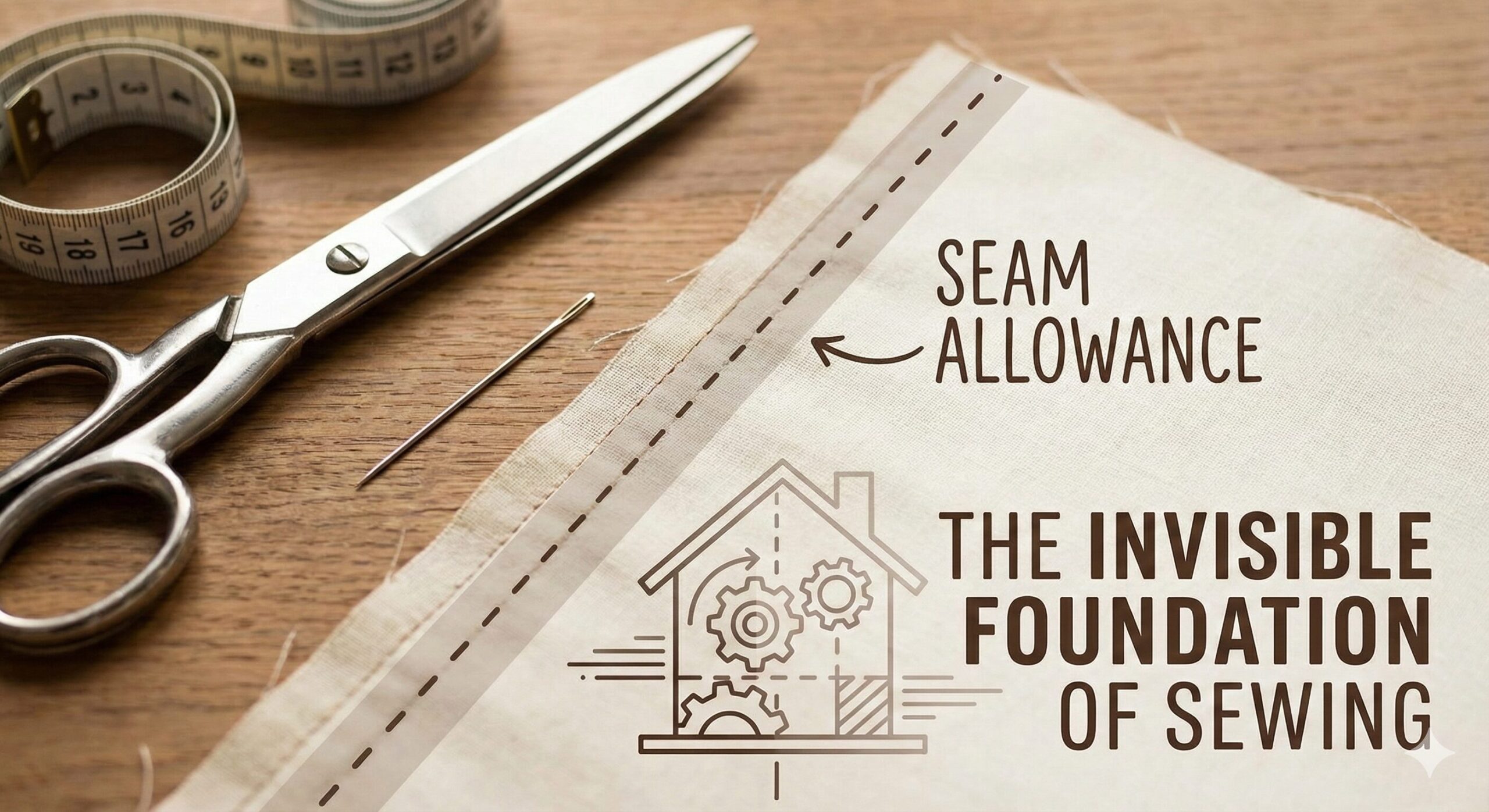
Seam Allowance is the distance between the edge of the fabric (the raw edge) and the line of stitching. It acts as a safety buffer that secures the fabric layers together.
According to Wikipedia, standards vary by industry, but maintaining a consistent width is critical for the finished size of the project.
Visualizing the Concept
Raw Edge (Right) vs. Stitch Line (Red)
1. Standard Allowances (The Rule of Thumb)
Not all patterns use the same allowance. If you assume everything is 5/8″ and sew a quilt block (which is 1/4″), your quilt will be tiny and the pieces won’t fit.
| Measurement | Common Use Case | Reason |
|---|---|---|
| 5/8″ (1.5cm) | Commercial Garment Patterns (Simplicity, Vogue) | Allows room to “let out” the garment for fitting adjustments. |
| 1/2″ (1.2cm) | Indie Patterns & Knitwear | Reduces bulk; usually serged off immediately. |
| 1/4″ (6mm) | Quilting & Doll Clothes | Precision piecing; minimal bulk. |
| 3/8″ (1cm) | Zippers & Collars | Used in enclosed seams to reduce bulk when turning right-side out. |
2. How to Keep Your Seams Straight
Knowing the measurement is one thing; sewing a perfectly straight line at that measurement is another. If your seam allowance wobbles, your clothing seams will look wavy.
Most sewing machines have lines etched into the metal throat plate (the metal plate under the needle). These lines mark distance from the center needle position. However, these lines can be hard to see.
The Solution: Magnetic Guides
A magnetic seam guide sticks to the metal plate of your machine. It creates a physical wall that the edge of your fabric bumps against, making it impossible to sew crooked.

Madam Sew Magnetic Seam Guide
This creates a raised edge at exactly the distance you need (e.g., 5/8″). Just slide your fabric along the wall for perfectly straight seams every time. Note: Do not use on computerized machines directly over the computer brain.
Check Price on AmazonRelated: Is it safe to use magnets on computerized machines?
3. Measuring Tools You Need
You cannot eyeball a 5/8″ seam. You need a specific tool called a Seam Gauge. Unlike a floppy tape measure, a seam gauge is a stiff metal ruler with a sliding marker.
You use this to check your needle position before you start sewing, and to measure hems while pressing.

Dritz Sewing Gauge
The essential tool for every sewist. Use the blue slider to mark your desired seam allowance, then use it to double-check that your machine’s needle is actually dropping in the right spot.
Check Price on Amazon4. Finishing the Allowance
Once you sew the seam, you are left with a raw flap of fabric (the allowance). If you leave this raw, it will fray when washed. You must “finish” the seam allowance.
- Pinking Shears: Scissors with zig-zag teeth that cut the fabric in a way that prevents fraying. (See our Scissors Guide)
- Zig-Zag Stitch: Use your machine to sew a zig-zag stitch along the raw edge.
- Serging: A serger cuts the edge and wraps it in thread in one pass. This is the professional finish you see on t-shirts.
5. Video Tutorial: Seam Allowance Explained
Sometimes it helps to see the concept in motion. This video breaks down how to measure and sew accurate allowances.
6. Troubleshooting Common Issues
Problem: My garment is too small.
Cause: You likely used a larger seam allowance than the pattern called for. Taking 6/8″ instead of 5/8″ removes 1 inch of fabric for every 4 seams!
Problem: My pieces don’t line up.
Cause: Inconsistent allowance. If you wobbled while sewing, one piece effectively became shorter than the other. Use a solid sewing table to reduce vibration and fabric drag.
7. Comprehensive Seam Allowance Conversion Charts
Working with international patterns or sewing tools requires precise conversion between imperial and metric measurements. This comprehensive conversion guide ensures accuracy across all measurement systems.
Imperial to Metric Seam Allowance Conversions
| Imperial (Inches) | Decimal (Inches) | Metric (Millimeters) | Metric (Centimeters) | Common Applications |
|---|---|---|---|---|
| 1/16″ | 0.0625″ | 1.6 mm | 0.16 cm | Leatherwork, ultra-precise couture |
| 1/8″ | 0.125″ | 3.2 mm | 0.32 cm | Quilting (foundation paper piecing) |
| 3/16″ | 0.1875″ | 4.8 mm | 0.48 cm | Miniature clothing, doll making |
| 1/4″ | 0.25″ | 6.4 mm | 0.64 cm | Standard quilting, patchwork |
| 5/16″ | 0.3125″ | 7.9 mm | 0.79 cm | Some indie patterns, European patterns |
| 3/8″ | 0.375″ | 9.5 mm | 0.95 cm | Zippers, collars, enclosed seams |
| 7/16″ | 0.4375″ | 11.1 mm | 1.11 cm | Vintage patterns, tailoring |
| 1/2″ | 0.5″ | 12.7 mm | 1.27 cm | Indie patterns, knitwear, home decor |
| 5/8″ | 0.625″ | 15.9 mm | 1.59 cm | Commercial garment patterns (Big 4) |
| 3/4″ | 0.75″ | 19.1 mm | 1.91 cm | Upholstery, heavy canvas, workwear |
| 7/8″ | 0.875″ | 22.2 mm | 2.22 cm | Historical costumes, special applications |
| 1″ | 1.0″ | 25.4 mm | 2.54 cm | Leather, marine canvas, industrial |
8. Industrial Seam Standards and Specifications
Industrial sewing operates under different standards than home sewing. Understanding these specifications is crucial for professional-quality results and when working with commercial patterns.
Apparel Manufacturing Standards (ASTM/ISO)
| Garment Type | Standard Allowance | Minimum Allowance | Finishing Method | Industry Standard Code |
|---|---|---|---|---|
| Woven Shirts/Blouses | 10mm (3/8″) | 6mm (1/4″) | Overlock or Clean Finish | ASTM D6193-16 |
| Dresses/Skirts | 15mm (5/8″) | 10mm (3/8″) | Overlock or Bound | ISO 4916:1991 |
| Pants/Trousers | 15mm (5/8″) | 10mm (3/8″) | Flat-felled or Overlock | ASTM D5585-95 |
| Jackets/Coats | 20mm (3/4″) | 15mm (5/8″) | Bound or Hong Kong | ISO 4915:1991 |
| Lingerie/Swimwear | 6mm (1/4″) | 3mm (1/8″) | Coverstitch or Serged | ASTM D4235-18 |
| Children’s Wear | 10mm (3/8″) | 6mm (1/4″) | Overlock or French Seam | CPSC 16 CFR 1610 |
| Uniforms/Workwear | 20mm (3/4″) | 15mm (5/8″) | Double-stitched or Flat-felled | ISO 3759:2011 |
9. Seam Grading and Layering Techniques
Seam grading (also called layering or trimming) is the process of trimming seam allowances to different widths to reduce bulk in enclosed seams. This technique is essential for professional-looking collars, cuffs, and facings.
Standard Grading
Technique: Trim each layer to different widths
Typical Sequence: 1/4″ → 3/8″ → 1/2″
Application: Collars, cuffs, waistbands
Goal: Eliminate ridge lines on right side
Curve Grading
Technique: Clip concave curves, notch convex curves
Spacing: Clips every 1/2″ to 3/4″
Application: Armholes, necklines, princess seams
Goal: Allow fabric to lie flat when turned
Corner Grading
Technique: Trim diagonally across corners
Distance: 1/8″ from stitch line at point
Application: Collar points, pocket corners
Goal: Sharp, crisp corners without bulk
Grading Standards for Different Seam Types
| Seam Type | Total Allowance | Layer 1 (Top) | Layer 2 (Middle) | Layer 3 (Bottom) | Special Tools |
|---|---|---|---|---|---|
| Standard Collar | 5/8″ (15mm) | 1/4″ (6mm) | 3/8″ (10mm) | 1/2″ (12mm) | Grading scissors, curved shears |
| French Cuff | 1/2″ (12mm) | 3/16″ (5mm) | 1/4″ (6mm) | 3/8″ (10mm) | Applique scissors, embroidery scissors |
| Waistband (Heavy) | 3/4″ (20mm) | 1/4″ (6mm) | 3/8″ (10mm) | 5/8″ (15mm) | Duckbill applique scissors |
| Lapel/Facing | 5/8″ (15mm) | 3/16″ (5mm) | 5/16″ (8mm) | 1/2″ (12mm) | Curved grading shears |
| Bias Binding | 3/8″ (10mm) | 1/8″ (3mm) | 1/4″ (6mm) | N/A (two layers) | Binding clips, bias tape maker |
10. French Seam Calculations and Engineering
French seams are elegant, enclosed seams perfect for sheer fabrics and garments where raw edges shouldn’t show. Understanding the mathematics behind French seam construction ensures perfect results every time.
Wrong-Side Stitching
Calculation: Pattern seam allowance ÷ 2
Example: For 5/8″ allowance: 5/8″ ÷ 2 = 5/16″
Process: Sew wrong sides together at calculated distance
Check: Trim allowance to 1/8″ after stitching
Right-Side Encasement
Calculation: Pattern seam allowance ÷ 2
Example: Remaining 5/16″ folded over trimmed edge
Process: Press, fold right sides together, stitch at full allowance
Result: Perfectly enclosed raw edges
Finished Dimensions
Visible Seam: Pattern seam allowance width
Enclosed Raw Edges: Zero exposure
Strength: Two lines of stitching
Bulk: Minimal (single fabric thickness)
French Seam Allowance Guide
| Fabric Type | Total Allowance | First Stitch | Trim To | Second Stitch | Final Width |
|---|---|---|---|---|---|
| Sheer (Voile, Organza) | 1/2″ (12mm) | 1/4″ (6mm) | 1/8″ (3mm) | 1/4″ (6mm) | 1/4″ (6mm) |
| Lightweight (Cotton, Silk) | 5/8″ (15mm) | 5/16″ (8mm) | 1/8″ (3mm) | 5/16″ (8mm) | 5/16″ (8mm) |
| Medium Weight (Linen, Wool) | 3/4″ (20mm) | 3/8″ (10mm) | 1/4″ (6mm) | 3/8″ (10mm) | 3/8″ (10mm) |
| Heavy (Denim, Canvas) | 1″ (25mm) | 1/2″ (12mm) | 1/4″ (6mm) | 1/2″ (12mm) | 1/2″ (12mm) |
11. Flat-Felled Seam Engineering for Denim and Workwear
Flat-felled seams are the gold standard for durability in workwear, jeans, and shirts. This seam construction involves encasing raw edges within the seam itself, creating a smooth, durable finish on both sides.
Traditional Flat-Felled
Total Allowance: 1″ (25mm)
First Stitch: 5/8″ (15mm)
Trim Layer: Trim one layer to 1/8″ (3mm)
Fold & Stitch: Fold wider allowance over trimmed edge, stitch at 1/4″ (6mm)
Applications: Jeans, work shirts, uniforms
Mock Flat-Felled
Total Allowance: 5/8″ (15mm)
Stitch & Press: Sew at 5/8″, press allowances to one side
Topstitch: Stitch 1/4″ (6mm) from seam line
Trim: Trim close to topstitching
Applications: Medium-weight fabrics, home sewing
Lapped Seam (Industrial)
Allowance: One piece 1/2″, other piece 1″
Lap & Stitch: Lap narrower over wider, stitch through all layers
Edge Stitch: Second row of stitching at edge
Applications: Industrial workwear, leather goods
Flat-Felled Seam Specifications
| Product Type | Total Fabric Used | Visible Topstitching | Seam Strength (psi) | Industrial Stitch Type | Thread Weight |
|---|---|---|---|---|---|
| Denim Jeans | 1.25″ (32mm) | 2 rows, 1/8″ apart | 45-55 psi | 401 Chainstitch | Tex 40 (heavy) |
| Work Shirt | 1″ (25mm) | 1 row, 1/4″ from edge | 35-45 psi | 301 Lockstitch | Tex 50 (medium) |
| Canvas Workwear | 1.5″ (38mm) | 3 rows, 1/4″ spacing | 60-75 psi | 401 Chainstitch | Tex 30 (extra heavy) |
| Outdoor Gear | 1.25″ (32mm) | 2 rows with bartacks | 50-65 psi | 304 Zigzag Lockstitch | Tex 40 with coating |
12. Hong Kong Finish Mathematics
The Hong Kong finish (also called bias-bound seam finish) is a couture technique that encloses raw edges with bias tape. The mathematics involve precise calculations for bias strip width based on seam allowance.
Bias Strip Width = (Seam Allowance × 2) + 1/4″ (6mm)
Example for 5/8″ seam: (5/8″ × 2) + 1/4″ = 1 1/2″ (38mm)
Breakdown: 5/8″ wraps around front, 5/8″ wraps around back, 1/4″ for turn-under and stitching allowance.
Hong Kong Finish Specifications
| Seam Allowance | Bias Strip Width | Finished Width | Fabric Usage | Best Applications |
|---|---|---|---|---|
| 1/4″ (6mm) | 3/4″ (20mm) | 1/4″ (6mm) | Low | Quilting, lightweight garments |
| 3/8″ (10mm) | 1″ (25mm) | 3/8″ (10mm) | Medium | Blouses, dresses, linings |
| 1/2″ (12mm) | 1 1/4″ (32mm) | 1/2″ (12mm) | Medium-High | Jackets, coats, medium-weight |
| 5/8″ (15mm) | 1 1/2″ (38mm) | 5/8″ (15mm) | High | Tailoring, wool garments |
| 3/4″ (20mm) | 1 3/4″ (45mm) | 3/4″ (20mm) | Very High | Coats, heavy fabrics |
13. Fabric-Specific Seam Allowance Requirements
Different fabrics behave differently and require specific seam allowance considerations. This comprehensive guide covers allowances for all major fabric types.
Sheer Fabrics
Allowance: 1/4″ – 3/8″
Finish: French or narrow rolled
Needle: 60/8 – 70/10
Thread: 50-60 weight
Lightweight Wovens
Allowance: 3/8″ – 1/2″
Finish: Pinked or serged
Needle: 70/10 – 80/12
Thread: 40-50 weight
Medium Weight Wovens
Allowance: 5/8″
Finish: Serged or bound
Needle: 80/12 – 90/14
Thread: 40 weight
Heavy Wovens
Allowance: 3/4″ – 1″
Finish: Flat-felled or bound
Needle: 100/16 – 110/18
Thread: 30-40 weight
Complete Fabric Seam Allowance Chart
| Fabric Type | Weight (oz/yd²) | Recommended Allowance | Minimum Allowance | Optimal Finish | Special Considerations |
|---|---|---|---|---|---|
| Organza/Chiffon | 0.5 – 1.0 | 1/4″ (6mm) | 3/16″ (5mm) | French or Narrow Rolled | Use tissue paper under seams |
| Silk Habotai | 1.5 – 2.0 | 3/8″ (10mm) | 1/4″ (6mm) | French or Hong Kong | Test tension on scrap first |
| Cotton Voile | 2.0 – 2.5 | 3/8″ (10mm) | 1/4″ (6mm) | Pinked or Serged | Use sharp microtex needle |
| Quilting Cotton | 3.0 – 4.0 | 1/4″ (6mm) | 3/16″ (5mm) | Press Open | Shorter stitches for accuracy |
| Linen | 4.0 – 6.0 | 5/8″ (15mm) | 1/2″ (12mm) | Bound or Serged | Pre-wash to account for shrinkage |
| Wool Crepe | 6.0 – 8.0 | 5/8″ (15mm) | 1/2″ (12mm) | Hong Kong or Bound | Use woolly nylon thread in bobbin |
| Denim (10oz) | 10.0 – 12.0 | 3/4″ (20mm) | 5/8″ (15mm) | Flat-felled | Use jeans needle, heavy thread |
| Canvas/Duck | 12.0 – 15.0 | 1″ (25mm) | 3/4″ (20mm) | Double-stitched | Walking foot essential |
| Jersey Knit | 4.0 – 6.0 | 1/2″ (12mm) | 3/8″ (10mm) | Serged or Zig-zag | Ballpoint needle, stretch stitch |
| French Terry | 8.0 – 10.0 | 5/8″ (15mm) | 1/2″ (12mm) | Serged | Differential feed on serger |
14. Historical Evolution of Seam Allowance Standards
Seam allowance standards have evolved significantly over centuries, influenced by fabric availability, sewing technology, and fashion trends. Understanding this history provides context for modern practices.
Hand Sewing Era
Allowance: 1/2″ – 1″ (variable)
Reason: Hand stitches weaker, needed more fabric
Method: Running stitch, backstitch
Fabric Cost: High – minimal waste
Early Machine Sewing
Allowance: 3/8″ – 1/2″
Reason: Machine stitches stronger
Technology: Straight stitch only
Industrialization: Mass production begins
Standardization Era
Allowance: 5/8″ becomes standard
Reason: Commercial pattern industry grows
Technology: Zig-zag machines introduced
Fabric: Synthetic fibers introduced
Modern Specialization
Allowance: Multiple standards
Reason: Different applications, fabric types
Technology: Sergers, coverstitch, computerized
Globalization: Metric/Imperial standardization
15. Seam Allowance in Pattern Drafting Mathematics
Understanding how seam allowance affects pattern drafting is crucial for creating custom patterns or altering commercial ones. The mathematics involve precise calculations for finished garment dimensions.
Finished Pattern Piece = Body Measurement + Ease + (Seam Allowance × 2)
Example for 36″ bust with 2″ ease and 5/8″ allowance:
36″ + 2″ + (5/8″ × 2) = 36″ + 2″ + 1.25″ = 39.25″ total pattern width
Key Insight: Seam allowance is added twice – once for each side of each pattern piece.
Pattern Allowance Calculations
| Pattern Component | Typical Allowance | Drafting Formula | Adjustment for Curves | Special Cases |
|---|---|---|---|---|
| Side Seams | 5/8″ (15mm) | Body + Ease + 1.25″ | None | Princess seams: check intersection points |
| Shoulder Seams | 5/8″ (15mm) | Shoulder length + 1.25″ | None | Raglan: measure from neck point |
| Armholes | 5/8″ (15mm) | Armhole curve + 1.25″ | True curves after adding allowance | Set-in vs. dropped shoulders different |
| Necklines | 3/8″ (10mm) | Neck curve + 0.75″ | Clip curves after stitching | Faced vs. bound necklines differ |
| Hems | 1″ – 3″ (25-75mm) | Garment length + (hem × 2) | Grade hem allowance on curves | Circular skirts: bias stretch allowance |
16. Seam Allowance for Stretch Fabrics
Knits and stretch wovens require special seam allowance considerations due to their elasticity and recovery properties. Incorrect allowances can cause popped seams or excessive stretching.
Knit Garments
Allowance: 1/2″ (12mm)
Reason: Reduces bulk in seams
Finish: Serged immediately
Stretch: 50-100% recovery needed
Swimwear/Activewear
Allowance: 3/8″ (10mm)
Reason: Maximum stretch, minimal bulk
Finish: 3-thread overlock
Stretch: 100-200% recovery
Stretch Wovens
Allowance: 5/8″ (15mm)
Reason: Standard with stretch stitch
Finish: Zig-zag or serged
Stretch: 10-25% recovery
17. Seam Testing Protocols and Standards
Professional garment manufacturers use standardized testing protocols to determine optimal seam allowances for different applications. Implementing these protocols ensures durability and quality.
ASTM/ISO Seam Strength Testing
| Test Type | Standard Code | Minimum Strength | Allowance Tested | Application |
|---|---|---|---|---|
| Seam Strength | ASTM D1683 | 22 lbf (98N) | 5/8″ (15mm) | General apparel |
| Seam Slippage | ASTM D434 | < 0.25" (6mm) | 5/8″ (15mm) | Woven fabrics |
| Seam Stretch | ISO 17976 | 30% minimum | 1/2″ (12mm) | Knit garments |
| Seam Durability | AATCC 88B | 50 wash cycles | 5/8″ (15mm) | All garments |
| Seam Puckering | AATCC 88C | Rating 3.5+ | Various | Quality control |
18. Couture Seam Allowance Techniques
High-fashion and couture sewing employ specialized seam allowance techniques that differ from commercial standards. These methods prioritize finish quality, durability, and aesthetics over production speed.
Haute Couture Allowances
Standard: 1″ – 2″ (25-50mm)
Reason: Multiple fittings, alterations
Finish: Hand-overcast or bound
Time: 50-100 hours per garment
Bespoke Tailoring
Standard: 1.5″ – 3″ (38-75mm)
Reason: Lifetime alterations
Finish: Pick stitching, hand finishing
Construction: Full canvas, hand pad stitching
Bridal/Costume
Standard: 1″ – 1.5″ (25-38mm)
Reason: Complex constructions, heavy fabrics
Finish: Bound, Hong Kong, or bias-taped
Special: Boning channels, structural seams
19. Seam Allowance for Leather and Vinyl
Non-woven materials like leather, vinyl, and faux leather require fundamentally different seam allowance approaches due to their inability to fray and permanent needle hole damage.
Leather/Vinyl Seam Standards
| Material Type | Thickness | Minimum Allowance | Optimal Allowance | Stitch Length | Special Equipment |
|---|---|---|---|---|---|
| Light Leather (1-2oz) | 0.4-0.8mm | 3/8″ (10mm) | 1/2″ (12mm) | 3.0-3.5mm | Leather needle, Teflon foot |
| Medium Leather (3-4oz) | 1.2-1.6mm | 1/2″ (12mm) | 5/8″ (15mm) | 3.5-4.0mm | Walking foot, leather awl |
| Heavy Leather (5-6oz) | 2.0-2.4mm | 5/8″ (15mm) | 3/4″ (20mm) | 4.0-4.5mm | Industrial machine, harness needle |
| Vinyl/PVC | 0.5-1.0mm | 3/8″ (10mm) | 1/2″ (12mm) | 3.0-3.5mm | Teflon or roller foot |
| Faux Leather | 0.8-1.2mm | 1/2″ (12mm) | 5/8″ (15mm) | 3.0-3.5mm | Teflon foot, tissue paper |
20. Quilting Precision and Seam Allowance Mathematics
Quilting requires extreme precision in seam allowances. A 1/16″ error in each seam can result in blocks that are 1″ too small or large when multiplied across a quilt.
Final Block Size = (Cut Size – (Seam Allowance × 2)) × Number of Pieces
Example for 2.5″ squares with 1/4″ seams:
Each seam reduces size by 1/2″ (1/4″ each side)
4 squares = (2.5″ – 0.5″) × 4 = 8.0″ finished block
Key Insight: Quilters must account for seam allowance in both cutting and pressing.
Quilting Seam Allowance Guide
| Quilting Technique | Standard Allowance | Precision Tolerance | Special Tools | Common Errors |
|---|---|---|---|---|
| Traditional Piecing | 1/4″ (6mm) | ± 1/32″ (0.8mm) | 1/4″ presser foot, seam guide | Inconsistent pressing, stretching bias |
| Foundation Paper Piecing | Scant 1/4″ (5mm) | ± 1/64″ (0.4mm) | Add-a-quarter ruler, paper scissors | Not trimming after each seam |
| English Paper Piecing | 3/8″ – 1/2″ (10-12mm) | ± 1/16″ (1.6mm) | Paper templates, glue pen | Uneven basting stitches |
| Appliqué | 1/8″ – 1/4″ (3-6mm) | ± 1/32″ (0.8mm) | Appliqué scissors, turning tool | Clipping curves too close |
| Whole Cloth Quilting | 1/2″ – 1″ (12-25mm) | ± 1/8″ (3mm) | Quilting rulers, marking tools | Not accounting for quilting shrinkage |
21. Home Decor and Upholstery Seam Allowances
Home decor projects like curtains, cushions, and upholstery require different seam allowance considerations due to scale, function, and fabric types.
Curtains/Drapes
Allowance: 1″ – 3″ (25-75mm)
Reason: Hem adjustments, weight distribution
Finish: Double-fold hems, lined
Special: Account for fabric drop over time
Cushions/Pillows
Allowance: 1/2″ – 1″ (12-25mm)
Reason: Insert fit, seam strength
Finish: Serged or zig-zag
Special: Zipper allowance additional
Upholstery
Allowance: 1″ – 2″ (25-50mm)
Reason: Fabric stretching, staple placement
Finish: Raw (will be stapled)
Special: Pattern matching allowance additional
22. Comprehensive FAQ Section
5/8″ (15.875mm) became the American commercial standard because it provides enough fabric for professional finishing methods (overlocking, binding) while allowing room for alterations. It’s a balance between fabric economy and functionality. European patterns often use 1.5cm (approximately 5/8″).
1. Draft your pattern without allowances (the “seam line”). 2. Use a seam allowance ruler or French curve to add consistent allowance outside all edges. 3. For curves, add allowance perpendicular to the seam line, not parallel. 4. Mark notches before adding allowance. 5. Transfer all markings to the allowance area.
A “scant” 1/4″ is about 1-2 threads less than a true 1/4″ (approximately 5mm vs 6mm). This accounts for the fabric taken up in the fold when pressing. A “generous” 1/4″ is slightly more than true 1/4″. Most quilters use scant 1/4″ for perfect piecing. Test by sewing three 2.5″ strips together – they should measure exactly 6.5″ wide.
Yes, but carefully. 1. Trace the original pattern. 2. Redraw seam lines at your preferred distance. 3. Remember that changing allowance affects: finished size (1/2″ change = 1″ size change), pattern piece matching (notches may need moving), and fabric requirements (larger allowance uses more fabric). Always make a muslin first.
Pre-1950s patterns often used 1/2″ allowances because: 1. Fabrics were more expensive (less waste). 2. Home sewing machines were less powerful (thinner seams easier). 3. Garments were more fitted (less ease built in). 4. Sewing techniques differed (more hand finishing). Always check vintage pattern instructions for their specific allowance.
Seam allowance directly impacts fabric yardage: 1/4″ vs 5/8″ allowance can change fabric needs by 10-15%. Wider allowances also affect cutting layout efficiency. When substituting allowance sizes, add 10% extra fabric when going larger, but don’t reduce when going smaller (layout efficiency improves with smaller allowances).
For heavy fabrics like canvas or denim: 1. Use 3/4″ to 1″ allowance. 2. Flat-felled or lapped seam construction. 3. Double-stitch or use safety stitch. 4. Heavy thread (Tex 30-40). 5. Appropriate needle (100/16-110/18). 6. Consider seam reinforcement at stress points. Test seam strength with a “break test” on scraps.
1. Use a curved seam guide or adjustable guide. 2. For concave curves (necklines, armholes), clip allowance after sewing to allow flattening. 3. For convex curves (sleeve caps, collars), notch allowance to reduce bulk. 4. Go slowly, repositioning fabric frequently. 5. Consider using staystitching just inside seam line before cutting curves.
23. Professional Workflow and Efficiency
Professional sewists and manufacturers develop efficient workflows for managing seam allowances that maximize quality while minimizing time and fabric waste.
Production Seam Allowance Workflow
| Production Stage | Allowance Action | Tools Used | Quality Check | Time Allowance |
|---|---|---|---|---|
| Pattern Cutting | Include in pattern | Pattern paper, allowance ruler | Measure multiple points | 5% of total time |
| Fabric Cutting | Cut with allowance | Rotary cutter, weights, mat | Check against pattern | 15% of total time |
| Sewing | Maintain consistency | Seam guide, magnetic helper | Spot check every 10 seams | 50% of total time |
| Finishing | Trim/grade as needed | Grading scissors, pinking shears | Visual inspection | 20% of total time |
| Pressing | Press allowances | Iron, clapper, seam roll | Check for flatness | 10% of total time |
Conclusion: Mastering the Invisible Foundation
Seam allowance is the invisible hero of sewing. It dictates the fit, the durability, and the finish of your project. Always check your pattern instructions first—never assume it’s 5/8″.
Ready to practice? Pick up some high-quality cotton thread and test your accuracy on scrap fabric today.