Singer 4411 vs 4423: Battle of the Heavy Duty Beasts
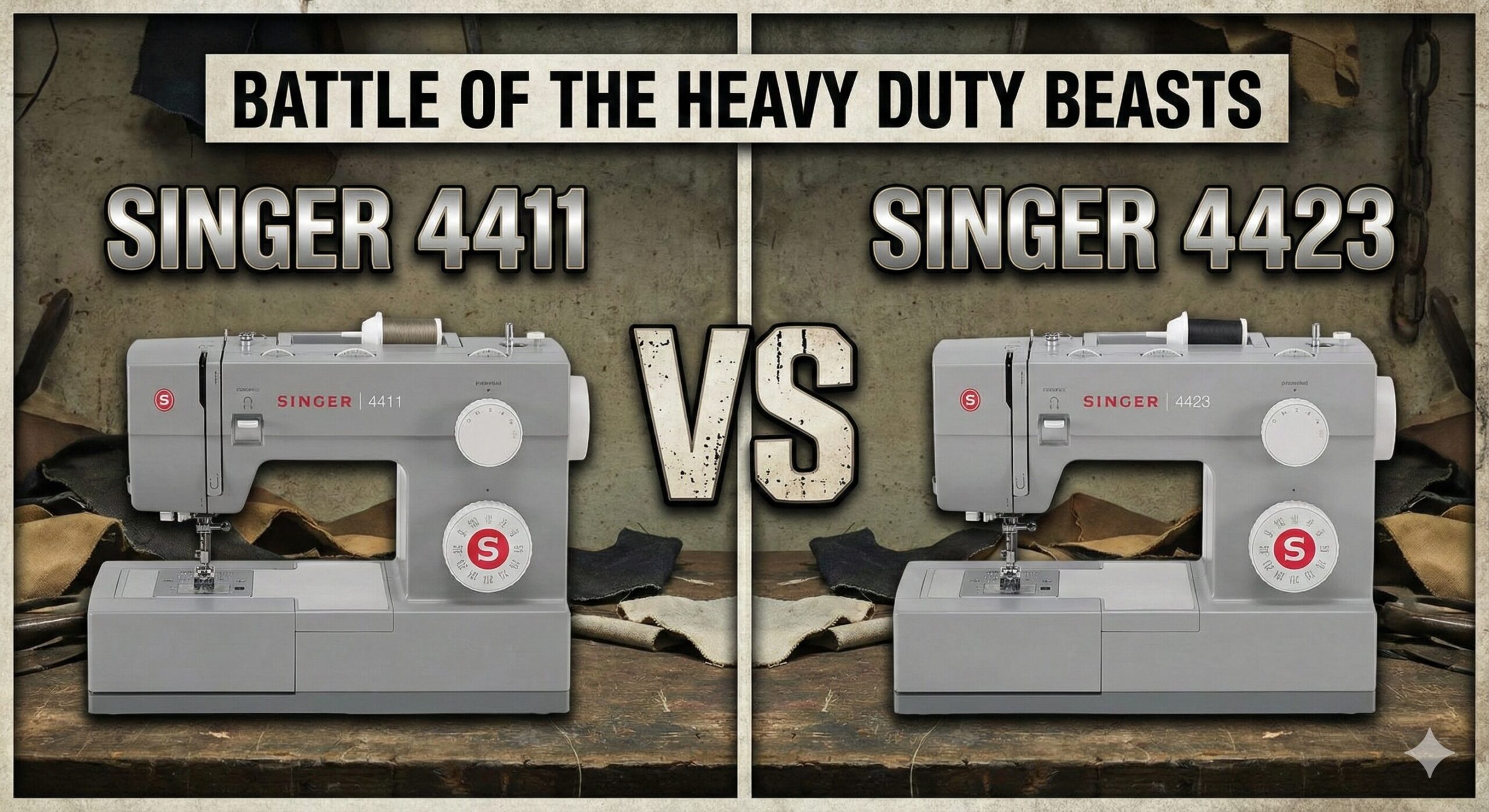
If you have ever walked into a fabric store or browsed Amazon for a sewing machine that looks like it could survive a small earthquake, you have seen the grey “Heavy Duty” line from Singer. They are iconic. They look industrial, they sound powerful, and they promise to sew through denim like butter. But when you look closer, you see two models that look almost identical: the Singer 4411 vs 4423.
Visually, they are twins. They share the same motor, the same metal frame, and the same stainless steel bedplate. Yet, there is a price difference, and there are subtle feature changes that can make or break your sewing experience depending on your skill level. Is the 4423 worth the extra cash for a few more stitches and an automatic buttonhole? Or is the 4411 the ultimate budget workhorse for the minimalist sewist?
At Sewing Device, we have put these machines through the wringer—from hemming jeans to stitching delicate cottons. In this comprehensive comparison, we will break down the mechanics, the usability, and the value proposition of both models to help you decide which grey beast belongs on your sewing table.
At a Glance: The Tale of the Tape
Before we dive into the nitty-gritty of motors and buttonholes, here is the high-level specification breakdown. As you can see, the core chassis is the same, but the creature comforts differ.
| Feature | Singer 4411 Heavy Duty | Singer 4423 Heavy Duty |
|---|---|---|
| Best For | Strict Budgets, Simple Repairs, Utilitarian Sewing | Beginners who want convenience, Garment Sewers |
| Built-in Stitches | 11 (6 Basic, 4 Decorative, 1 Buttonhole) | 23 (6 Basic, 12 Decorative, 4 Stretch, 1 Buttonhole) |
| Buttonhole Type | 4-Step (Manual) | 1-Step (Automatic) |
| Needle Threader | No (Manual threading required) | Yes (Built-in Automatic Threader) |
| Sewing Speed | 1,100 SPM (Stitches Per Minute) | 1,100 SPM (Stitches Per Minute) |
| Motor | Standard HD Motor (60% stronger than standard) | Standard HD Motor (60% stronger than standard) |
| Frame | Heavy Duty Metal Frame | Heavy Duty Metal Frame |
The Engine Room: Performance and Power
The most important thing to understand about the Singer 4411 vs 4423 comparison is that under the plastic grey hood, they are effectively the same machine. This is good news.
The “Heavy Duty” Claim
Both machines boast a motor that Singer claims is 60% stronger than their standard domestic machines. What does this mean in reality? It means torque. Both machines can pierce through multiple layers of denim, canvas, or thin leather without stalling, provided you use the correct needles. If you are constantly dealing with sewing machine needle problems on a standard white plastic machine, moving to either of these will feel like a significant upgrade.
Speed Demons
Both the 4411 and 4423 top out at 1,100 stitches per minute (SPM). To put that in perspective, most standard home machines sew at about 750-850 SPM. This extra speed is fantastic for long straight seams—think curtains, quilting bindings, or long costume hems. However, speed requires stability. Because both machines feature a heavy internal metal frame, they don’t bounce around as much as lighter models, though a sturdy table is still recommended.
If you are looking for a mechanical sewing machine that prioritizes raw power over computerized finesse, both models score equal points here. Neither has the “computerized” delay; you press the pedal, and they go.

The Powerhouse Upgrade: Singer 4423
Same motor, more features. Check the current price difference.
Check Price on AmazonThe 3 Major Differences That Matter
If the motor is the same, why pay more for the 4423? It comes down to three specific quality-of-life features. Depending on what you sew, these could be irrelevant or indispensable.
1. The Automatic Needle Threader
Singer 4411: Does NOT have an automatic needle threader. You have to squint and poke the thread through the eye of the needle manually. If you have good eyesight and steady hands, this is a non-issue.
Singer 4423: Has a built-in lever-style needle threader. It hooks the thread through the eye for you.
Verdict: If you struggle with vision or change thread colors frequently (like when doing decorative work), the 4423’s threader is a lifesaver.
2. The Buttonhole Mechanism
This is arguably the biggest mechanical difference.
- Singer 4411 (4-Step Buttonhole): This is the old-school way. You have to mark your fabric, sew the left side, stop, turn a dial, sew the bottom, stop, turn a dial, sew the right side… you get the idea. It requires manual measuring and precision to ensure the hole fits the button.
- Singer 4423 (1-Step Buttonhole): This is automatic. You place your actual button into a slot in the specialized foot, pull down a lever, and press the pedal. The machine sews the complete buttonhole in one go, perfectly sized to your button.
Verdict: If you plan to sew garments (shirts, pants, jackets), the 1-step buttonhole on the 4423 is worth the price of admission alone. It saves massive amounts of frustration.
3. Stitch Variety
Singer 4411: Offers 11 stitches. 6 are basic (straight, zigzag, blind hem), 4 are decorative, and 1 is the buttonhole. It is utilitarian.
Singer 4423: Offers 23 stitches. You get 12 decorative stitches and reinforced stretch stitches. While seasoned sewists often say “I only need a straight and zigzag stitch,” the reinforced stretch stitches on the 4423 are incredibly useful for sewing activewear or knits that need to stretch without popping seams.
Usability and Daily Operation
How do they feel to use? Both machines are designed to be intuitive. If you have read our sewing machine buying guide, you know that top-loading bobbins are the modern standard for ease of use.
Drop-in Bobbin System
Both the 4411 and 4423 feature a Top Drop-In Bobbin with a clear cover. This is excellent for beginners because you can see exactly how much thread you have left before you start a long seam. It is also generally less prone to jamming than older front-loading oscillating systems. However, if you do experience issues, check our guide on why is my sewing machine jamming—often it’s just lint buildup in the bobbin case.
Controls and Dials
These are mechanical machines. There are no LCD screens to navigate. You have large, grippy dials to change stitch length, width, and needle position. This tactile feedback is why many people prefer the Heavy Duty line over similarly priced computerized brothers (see our Singer vs Brother comparison). The controls are robust and withstand heavy use.
The Bedplate
Both feature a stainless steel bedplate. This allows fabric to glide smoothly over the machine arm. It’s a nice touch that mimics industrial machines, ensuring that rougher fabrics like canvas or denim don’t catch or drag.

The Budget Hero: Singer 4411
Simple, strong, and affordable. Perfect for basic repairs.
Check Price on AmazonPros and Cons: Head-to-Head
Singer 4411
- Price: Usually $30-$50 cheaper than the 4423.
- Simplicity: Fewer mechanics to break.
- Power: Same high-torque motor as the expensive models.
- Durability: Metal frame ensures longevity.
- No Auto Threader: Can be frustrating for some users.
- 4-Step Buttonhole: Tedious for garment making.
- Limited Stitches: Lacks specialized stretch stitches.
Singer 4423
- 1-Step Buttonhole: A massive time-saver for clothes.
- Auto Threader: Saves eyes and time.
- Versatility: More decorative and stretch stitch options.
- Value: High feature-to-price ratio.
- Price: Slightly more expensive.
- Plastic Knobs: While the frame is metal, dials are still plastic.
What Else Do You Need?
Buying the machine is step one. To get the “Heavy Duty” performance out of it, you need the right tools.
1. Needles: The number one reason users claim these machines “can’t sew denim” is that they are using a universal size 80 needle. You need Jeans/Denim Needles (Size 100/16 or 110/18). Check our guide on sewing machine needles to understand the difference.
2. Thread: Strong motors snap cheap thread. Use high-quality polyester or the best cotton threads to ensure your seams hold up to the machine’s tension.
3. Stability: While these machines are heavier than average, at 1,100 SPM, they can vibrate. A solid surface is key. If you are setting up a workspace, look into the best sewing tables designed to absorb vibration.
4. Cutting Tools: If you are working with thick fabrics, your scissors need to be sharp. Invest in professional sewing scissors or learn how to use a rotary cutter for precise lines.
Frequently Asked Questions
Can the Singer 4411 or 4423 sew leather?
Yes, both machines can sew soft garment leather (up to 3-4oz) and vinyl. You must use a Leather Needle and preferably a Teflon foot or Walking Foot to prevent the material from sticking to the presser foot. Do not attempt to sew thick saddle leather; for that, you need an industrial machine.
Is the Singer 4423 good for beginners?
Yes, the Singer 4423 is excellent for beginners. While it is fast, the foot pedal offers good control. The addition of the automatic needle threader and 1-step buttonhole makes it much more user-friendly than the 4411 for someone just learning how to use a sewing machine.
Does the Singer 4411 come with a case?
Typically, the Singer Heavy Duty line comes with a flimsy soft dust cover, not a hard carrying case. If you plan to travel with it to classes, you will likely need to purchase a separate hard case or padded bag.
Why is my Singer Heavy Duty machine loud?
These machines have powerful motors and metal frames, which naturally generate more noise than refined computerized plastic models like those from Husqvarna Viking. However, excessive clanking usually indicates a need for cleaning or oiling. Keep your bobbin area lint-free!
Final Verdict: Which Grey Beast Should You Buy?
After comparing the Singer 4411 vs 4423, the winner depends entirely on your budget and your patience.
Choose the Singer 4411 if:
- You are on a strict budget.
- You primarily do simple repairs (hemming pants, fixing curtains).
- You don’t care about buttonholes or decorative stitches.
- You have great eyesight and don’t mind threading needles manually.
Choose the Singer 4423 if:
- You are a beginner who wants a frustration-free experience (Auto threader is key!).
- You plan to make clothes (The 1-step buttonhole is non-negotiable for garments).
- You want the flexibility of stretch stitches for sewing knits and activewear.
- You want the best value-for-money in the Heavy Duty lineup.
In our opinion, the Singer 4423 is the better buy for most people. The small price increase ($20-$50 usually) pays for itself quickly in time saved threading needles and making buttonholes. It is a machine that can grow with you from basic repairs to full garment construction.
Ready to start sewing? Check the latest deals on Amazon.
See Today’s Best Price for Singer 4423